CONTEMPORARY IGBO ELITES AND THE POLITICS OF SELF-HATE, BOI-BOI AND AFIA NZAMA
74 views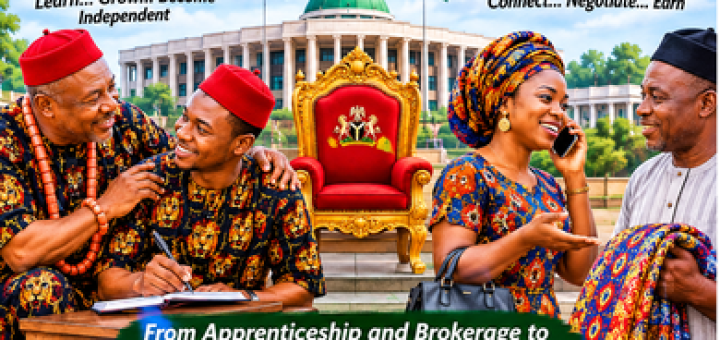
By Frank Ofili
This is one of those rare occasions when I deliberately set out to ruffle some Igbo political feathers. I believe some home truths need to be told, however uncomfortable they may be.
There is something increasingly troubling about the state of Igbo politics in contemporary Nigeria. It is not necessarily the absence of qualified men and women capable of aspiring to the highest political office in the country. Neither is it entirely the absence of political opportunities. Rather, it is the apparent inability of today’s Igbo political establishment to rally around its own, build a common political platform and project a credible national leadership ambition.
One cannot help wondering whether, since the days of Dr. Nnamdi Azikiwe, Dr. Alex Ekwueme and Senator Chuba Okadigbo, the Igbo have gradually lost some of the political confidence, assertiveness and strategic boldness that once characterised their participation in Nigerian politics.
Consider the present political dispensation. The Igbo do not appear to have a strong, coordinated political presence within the ruling All Progressives Congress (APC) capable of mounting a serious presidential challenge. In the Nigeria Democratic Congress (NDC), Peter Obi has emerged as a presidential contender. In the African Democratic Congress (ADC), the political landscape has been dominated by the ambitions of other prominent politicians. The same can be said of several other political platforms.
The question, therefore, is not simply whether an Igbo man or woman can obtain a presidential ticket. It is whether the Igbo political establishment possesses the cohesion, confidence and strategic organisation to produce and support a formidable national candidate.
And here lies the paradox.
Whenever an Igbo politician makes a serious attempt at the presidency, the hostility he sometimes encounters from fellow Igbo politicians can be as discouraging as the opposition he faces from outside the ethnic group. Instead of building bridges, consolidating support and negotiating strategically, some appear more interested in pulling down the aspirant, questioning his motives, undermining his ambition or deriding his political credentials.
Peter Obi’s political experience has brought this contradiction into sharp focus. His presidential ambition has attracted enormous enthusiasm, but also considerable opposition, including criticism from some Igbo political figures. One may disagree with his political strategy, question his policies or oppose his candidacy. That is legitimate politics. But there is a difference between constructive political disagreement and a seemingly determined effort to diminish one’s own political asset.
It raises an uncomfortable question: why should a people who complain about political exclusion sometimes appear so reluctant to encourage their own qualified political contenders?
THE POLITICS OF WAITING FOR A PRESIDENTIAL SETTLEMENT
I suspect that one of the fundamental problems with Igbo politics is a peculiar form of political naivety that has persisted since the Second Republic.
The Igbo appear to have embraced a political philosophy in which they expect the presidency to come to them through the benevolence, goodwill or political settlement of other ethnic groups. Rather than deliberately building a home-grown political platform through which they can mobilise, negotiate and pursue presidential power, many of their political leaders have preferred to individually align themselves with political parties and power structures dominated by other ethnic groups.
They call it nationalism. They call it national integration. They call it playing politics beyond ethnic boundaries.
There is nothing inherently wrong with any of these ideals. Indeed, Nigeria needs politicians who can transcend ethnic and religious boundaries. But nationalism without political strategy can become an exercise in political self-deception.
The uncomfortable question is: what exactly are the Igbo bringing to the bargaining table when they enter political negotiations as individuals or as scattered political interests within platforms controlled by other groups?
Politics is not a charitable enterprise. Political power is not distributed according to who has waited longest, who has suffered the most or who has demonstrated the greatest loyalty to a political arrangement. It is negotiated, contested and, where necessary, fought for through organisation, numbers, alliances and bargaining power.
The other groups understand this.
The Igbo, on the other hand, sometimes seem to believe that their time will eventually come simply because they have been patient, accommodating and nationalistic. Unfortunately, their time never seems to come. And perhaps it is because those with whom they expect to negotiate believe they have little or nothing substantial to bring to the table.
Whenever an Igbo politician makes a serious attempt at the presidency, the hostility he sometimes encounters from fellow Igbo politicians can be as discouraging as the opposition he faces from outside the ethnic group. Instead of building bridges, consolidating support and negotiating strategically, some appear more interested in pulling down the aspirant, questioning his motives, undermining his ambition or deriding his political credentials.
A political group that cannot demonstrate the capacity to mobilise its own people, sustain a political platform and negotiate from a position of collective strength will always find itself at the mercy of those who can.
This is where the Igbo political establishment needs a serious rethink.
There is perhaps no better illustration of this political disposition than a recent boast by the Minister of Works, David Umahi. I listened with some bemusement as he celebrated what he described as the historic fact that, for the first time in Nigeria’s history, an Igbo man had been appointed Minister of Works. One would have thought he was announcing the emergence of an Igbo President!
But why should the appointment of an Igbo man as Minister of Works be celebrated as though it were the ultimate political achievement of the Igbo? Is the office of Minister of Works now the ceiling of Igbo political aspiration? What happened to the ambition of producing the President and Commander-in-Chief of the Armed Forces of the Federal Republic of Nigeria?
There is nothing wrong with celebrating the appointment of an Igbo man to an important national office. Indeed, it is commendable. But there is a difference between celebrating political inclusion and mistaking political accommodation for political attainment.
A ministerial appointment, however important the ministry, is still an appointment within an existing political power structure. The President appoints the minister, defines the broad policy direction and ultimately exercises executive authority. The minister, regardless of his competence, influence or political stature, operates within that structure.
That is precisely the distinction I am trying to make. The problem is not that the Igbo are being appointed to important positions in governments headed by other ethnic groups. The problem is when such appointments become a substitute for the more ambitious pursuit of political power.
Perhaps this is where the Boi-Boi mentality becomes relevant. A political apprentice may consider his appointment into a powerful political establishment a major achievement, even when the ultimate objective ought to be acquiring the capacity to build and control his own political enterprise.
When political inclusion begins to be celebrated as the highest expression of collective political success, one begins to wonder whether the apprentice has lost sight of the purpose of the apprenticeship in the first place.
A BRIEF JOURNEY INTO HISTORY
To understand this apparent contradiction, it is necessary to revisit history.
Dr. Nnamdi Azikiwe, popularly known as Zik of Africa, was arguably one of the most consequential political figures produced by Nigeria. A nationalist, intellectual, journalist and politician, Zik was instrumental in the struggle for independence and became Nigeria’s first indigenous Governor-General before becoming its first President in 1963.
Yet, his political journey was not without disappointments. In the Second Republic, he contested the presidency under the Nigerian People’s Party (NPP) in 1979 and 1983 but lost to Shehu Shagari. His political influence notwithstanding, the presidency remained beyond his reach.
Then came Dr. Alex Ekwueme.
Ekwueme was Vice-President of Nigeria between 1979 and 1983 under President Shehu Shagari. A man of considerable intellectual depth, administrative experience and political sophistication, he returned to the political arena in 1998 as one of the leading figures in the formation of the People’s Democratic Party (PDP).
Indeed, the G-34, the political pressure group that opposed General Sani Abacha’s self-succession ambition and subsequently helped lay the foundation for the PDP, was led by Ekwueme.
Yet, when the party was choosing its presidential candidate for the 1999 election, Ekwueme was passed over in favour of Olusegun Obasanjo. The decision was driven by powerful political calculations and the preference of influential party stakeholders for Obasanjo.
Ekwueme’s subsequent political disappointment was a reminder that being a founding figure, possessing experience and enjoying political stature do not automatically translate into political power.
Then there was Senator Chuba Okadigbo, another formidable Igbo political personality. An accomplished political scientist, intellectual and orator, Okadigbo became President of the Senate in 1999. He was one of the most articulate political figures of his generation and was regarded by many as a potential national leader.
His political career, however, was turbulent. He was eventually removed as Senate President in 2000, amid controversies surrounding his leadership and allegations of financial impropriety. In 2003, he became the vice-presidential running mate to Muhammadu Buhari under the All Nigeria Peoples Party (ANPP).
These three personalities represented different generations of Igbo political ambition. They were not without their shortcomings, political disagreements or adversaries. But they possessed something that appears increasingly scarce today: an unapologetic belief that the Igbo could aspire to lead Nigeria.
A political group that cannot demonstrate the capacity to mobilise its own people, sustain a political platform and negotiate from a position of collective strength will always find itself at the mercy of those who can.
It is also important to acknowledge the wider historical circumstances. The January 1966 coup, the July counter-coup, the pogroms against Igbos and the Nigerian Civil War left deep scars on the Igbo political psyche. The post-war reintegration process, the political marginalisation many Igbos believe they have experienced, and the absence of a sustained national political structure have all contributed to the complicated relationship between the Igbo and the Nigerian state.
Consequently, it would be simplistic to attribute the Igbo political predicament entirely to internal divisions. Nigeria’s political structure, electoral arithmetic, elite bargaining and historical suspicions have also played significant roles.
Nevertheless, external obstacles cannot excuse internal weaknesses.
THE STRANGE CULTURE OF PULLING DOWN THEIR OWN
There is another troubling dimension to this problem: the apparent enthusiasm with which some Igbo people criticise, condemn, blackmail and frustrate fellow Igbo who dare to pursue the presidency.
I am not suggesting that other ethnic groups do not have internal political disagreements. They certainly do. But there appears to be a difference in how competing political ambitions are managed.
Consider the Hausa-Fulani political establishment. You will find individuals disagreeing over presidential candidates, supporting different political tendencies and openly declaring their preferences. But even where they disagree with a fellow Hausa-Fulani presidential aspirant, there is often a reluctance to turn that disagreement into a wholesale campaign of political destruction against their own compatriot. Their political differences do not necessarily erase the instinct to preserve their collective bargaining position.
Until Ndi Igbo learn to organise collectively, build political institutions, support credible contenders and negotiate from a position of strength, they may continue to occupy the uncomfortable position of political spectators, junior partners and intermediaries in a game of power they are perfectly qualified to play.
The Yoruba political establishment has its own rivalries and fierce internal contests. A Yoruba man may openly criticise another Yoruba presidential aspirant, question his competence and even campaign against his candidacy. But when election day arrives, the calculations of regional political interest can still influence how votes are cast. Political rivalry does not always translate into an eagerness to destroy the collective political prospects of the region.
Among the Igbo, however, one sometimes encounters a more troubling spectacle: an Igbo presidential aspirant is not merely opposed; he is subjected to sustained ridicule, denunciation and sometimes an almost obsessive campaign of discrediting by people from his own ethnic group. Some appear prepared to vote against their own compatriot simply to demonstrate their disagreement with him.
In other words, while others may disagree with their own, the Igbo sometimes seem determined to destroy their own.
Of course, this is not true of every Igbo person, and no ethnic group has a monopoly on political solidarity or betrayal. But the pattern is sufficiently visible to deserve examination.
Little wonder that the Igbo have found it difficult to convert their considerable population, intellectual resources, commercial influence and political experience into a sustained presidential bargaining advantage since the Second Republic.
And somehow, this political disposition appears to have found its way into sections of the Niger-Delta political establishment as well. Ethnic groups that ought to understand the importance of collective bargaining sometimes reproduce the same fragmentation, allowing individual political interests to take precedence over long-term regional political leverage.
THE BOI-BOI AND AFIA NZAMA MENTALITY IN IGBO POLITICS
This brings me to two interesting analogies from Igbo commercial culture: the Boi-Boi system and what is commonly known in Igbo market parlance as Afia Nzama.
Let me explain.
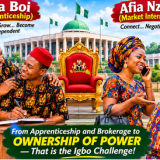
In Igbo commerce, particularly the traditional apprenticeship model known as Igba Boi, a young man serves an established businessman for an agreed period, learning the business, acquiring practical experience and eventually receiving settlement capital to establish his own enterprise.
It is a remarkable institution of economic empowerment. It has helped produce generations of entrepreneurs, distribute wealth and create opportunities for people who might otherwise have struggled to establish themselves.
But I wonder whether an unintended psychological dimension of this apprenticeship culture has found its way into Igbo politics.
In business, the apprentice is expected to learn, grow and eventually become independent. The relationship is not supposed to become one of permanent subordination. The apprentice must eventually develop the confidence to stand on his own, compete and build an enterprise of his own.
Could it be that some Igbo politicians have carried the apprenticeship mentality into politics, where they are more comfortable serving powerful political masters, negotiating subordinate positions and waiting for political favours than boldly pursuing independent national ambitions?
Could it be that the political equivalent of the Boi-Boi mentality has conditioned some of the political elite to see leadership through the prism of patronage rather than self-confidence, strategic independence and collective advancement?
There is something particularly ironic about this possibility. The same Igbo who have perfected the art of economic independence, entrepreneurship and commercial expansion appear, in certain respects, to have struggled with political independence and strategic self-assertion.
In commerce, the Igbo apprentice eventually wants to become a master. In politics, however, some seem content to remain political apprentices, serving political godfathers from other ethnic groups and waiting for their own political settlement.
But there is a fundamental difference between apprenticeship and permanent subordination. The purpose of apprenticeship is not to produce a perpetual servant. It is to produce an independent entrepreneur.
Why should the political equivalent be any different?
And then there is Afia Nzama.
In Igbo commercial usage, Afia Nzama refers to informal market intermediaries, usually young men and women who do not own shops or maintain substantial stocks of goods. Instead, they move around the market looking for customers, source goods from established traders or wholesalers, negotiate prices, facilitate transactions and add a small margin to the selling price as their earnings.
They are essentially market go-betweens, buying agents or commission-based trading intermediaries. Their business is not necessarily built around owning the merchandise. It is built around connecting those who own the goods with those who need them and making a margin from the transaction.
Now, here is where the political analogy becomes particularly interesting.
Could some sections of the Igbo political establishment have graduated from the Boi-Boi mentality only to embrace the Afia Nzama mentality?
Think about it.
The political Boi-Boi serves an established political master, hoping that someday he will be empowered to stand independently. The political Afia Nzama, on the other hand, does not necessarily aspire to own the political enterprise at all. He is content to serve as an intermediary between the political power centre and his own constituency, negotiating access, facilitating political transactions and collecting whatever political margin comes with the arrangement.
He does not own the political party. He does not control the political machinery. He does not determine who gets the presidential ticket. He may not even have the capacity to mobilise his people independently. But he can negotiate appointments, secure political favours, arrange endorsements and position himself as a political bridge between his ethnic constituency and the dominant political establishment.
His political relevance therefore depends less on the strength of the constituency he represents and more on his usefulness to the political power centre he serves.
That is the danger.
Rather than building an independent political structure through which the Igbo can negotiate national power, some politicians appear content to operate as political brokers, negotiating individual benefits and political accommodation within establishments controlled by others.
In such an arrangement, the politician may prosper, but the political constituency he claims to represent may remain perpetually dependent.
The distinction is important. The Boi-Boi at least has a business inheritance or independence as his ultimate destination. The Afia Nzama, however, can remain an intermediary indefinitely because his livelihood depends on the continued existence of the relationship between buyer and seller.
Politically speaking, why would such an intermediary be interested in building an independent political power base that could make his brokerage services unnecessary?
Why would he invest in an independent political platform when his immediate relevance comes from negotiating access to established power centres?
And why would he encourage a fellow Igbo politician to emerge as a formidable national political force if such an emergence could threaten his own position as the preferred political intermediary?
Of course, not every Igbo politician who participates in a national political party is a political broker, just as not every market intermediary lacks entrepreneurial ambition. Political alliances and brokerage are legitimate features of democratic politics. The problem arises when brokerage becomes a substitute for political ownership, and when individual political relevance takes precedence over collective political advancement.
Perhaps this explains why some Igbo political leaders appear more comfortable negotiating positions within other people’s political establishments than building institutions capable of producing and sustaining their own national leadership ambitions.
The question is no longer simply whether the Igbo have too many political apprentices. It is whether some have become so comfortable as political middlemen that they have lost the appetite to own the political enterprise.
THE NEED FOR AN IGBO POLITICAL PLATFORM
I have often wondered why the Igbo political establishment has not seriously considered building and sustaining a home-grown political party as a vehicle for its long-term presidential ambition.
I am not suggesting that such a party must be an exclusively ethnic organisation or that it should operate outside the framework of Nigerian nationalism. Rather, it should be a credible political platform originating from the South-East, with the capacity to attract Nigerians from other regions, articulate a national programme and negotiate presidential power from a position of institutional strength.
The Igbo do not necessarily need to win the presidency through such a party immediately. The more important objective would be to establish a political bargaining instrument that other political groups must reckon with.
A party with a disciplined membership, a clear ideological direction, a credible leadership structure and a demonstrable electoral base would give the Igbo something more substantial to negotiate with than individual political appointments, promises of political inclusion and the occasional vice-presidential nomination.
Without such a platform, individual Igbo politicians will continue to seek political accommodation within structures controlled by others. They will continue to negotiate for relevance rather than negotiate for power.
And there is a world of difference between the two.
Of course, no political party can win a Nigerian presidential election without building bridges beyond its regional stronghold. A home-grown Igbo political platform must therefore be national in ambition, inclusive in character and credible in its policy offerings. It must seek alliances without surrendering its independent bargaining capacity.
The objective is not ethnic isolation. It is strategic independence.
The Igbo must understand that being nationalistic does not require them to surrender their political bargaining power. One can be a Nigerian nationalist and still organise one’s constituency to compete effectively for national power.
THE POLITICS OF POWER AND THE WAY FORWARD
Since the return to democratic government in 1999, Nigeria has had presidents from the South-West, the North and the South-South. Olusegun Obasanjo and Bola Tinubu have occupied the presidency from the South-West; Umaru Musa Yar’Adua and Muhammadu Buhari from the North; and Goodluck Jonathan from the South-South.
The South-East, however, has not produced an elected President or Vice-President in the Fourth Republic. This is a significant political reality, even though Dr. Nnamdi Azikiwe was President in the First Republic and Major General Johnson Aguiyi-Ironsi was Nigeria’s first military Head of State.
The question is why.
Is it simply that other regions have refused to give the Igbo a chance? Or is there also a problem with the way the Igbo organise, negotiate and prosecute their own political ambitions?
The Yoruba and Hausa-Fulani political establishments have, at different times, demonstrated an ability to accommodate competing interests, manage internal disagreements and rally behind strategic political calculations. They are not without their divisions, rivalries or political betrayals. But when the question of national power arises, they have often demonstrated a capacity to negotiate from positions of considerable political strength.
The Igbo must ask themselves whether they have lost that capacity.
Ultimately, the presidency is not an ethnic entitlement. No Nigerian should become President simply because he belongs to a particular ethnic group. Competence, character, vision, national acceptability and the ability to unite the country must remain paramount.
But neither should any ethnic group be expected to apologise for aspiring to the highest office in the land.
The Igbo do not need to support every Igbo presidential aspirant blindly. They do not need to abandon critical thinking or surrender their political judgement in the name of ethnic solidarity. What they need is a political culture in which disagreements do not automatically translate into hostility, where ambition is not treated as an act of betrayal, and where a credible political contender is judged on his merits rather than destroyed by the very people whose collective political fortunes could benefit from his success.
Perhaps the greatest tragedy is not that the Igbo have yet to produce a President since the return to democracy in 1999. It is that, after decades of political experience, they still appear unable to develop a sustained, coherent and broadly supported strategy for attaining the office.
They also need to understand that political alliances should be partnerships, not master-servant relationships. There is nothing wrong with supporting another ethnic group’s presidential candidate, provided such support is based on clearly negotiated national interests and not on the assumption that political favours will eventually be returned.
The Igbo must stop confusing political accommodation with political advancement.
Perhaps the greatest tragedy is not that the Igbo have yet to produce a President since the return to democracy in 1999. It is that, after decades of political experience, they still appear unable to develop a sustained, coherent and broadly supported strategy for attaining the office.
So, I return to my original poser.
Are the Igbo being affected by the Boy-Boy mentality in their politics? Have they become so accustomed to serving political masters, negotiating subordinate positions and waiting for political settlements that they have lost the confidence to challenge for power on their own terms?
Or have some graduated from political Boy-Boys into political Afia Nzamas, content to serve as intermediaries between their people and established political power centres, negotiating political margins for themselves rather than building an independent political enterprise for their constituency?
Is their problem external political exclusion alone, or have they also become architects of their own political marginalisation through fragmentation, mutual suspicion and the curious habit of pulling down fellow Igbo who dare to aspire?
More fundamentally, have the Igbo lost their political mojo?
Perhaps the time has come for the Igbo to borrow a lesson from their own celebrated commercial culture.
The ultimate purpose of Igba Boi is not to remain a Boy-Boy forever. It is to graduate, become independent and eventually become a master of one’s own enterprise. And the purpose of commercial brokerage should not be confused with ownership of the business being brokered.
If the Igbo have mastered the art of economic self-reliance, entrepreneurship and commercial independence, why should they struggle to apply the same principles to politics?
The tragedy would be for a people who have mastered the art of building businesses, creating wealth, establishing commercial empires and competing successfully across Nigeria and beyond to remain political apprentices and middlemen in the very country they helped build.
Until they learn to organise collectively, build political institutions, support credible contenders and negotiate from a position of strength, they may continue to occupy the uncomfortable position of political spectators, junior partners and intermediaries in a game of power they are perfectly qualified to play.
And that, perhaps, is the greatest irony of Igbo politics: a people who have demonstrated extraordinary capacity for economic self-reliance may yet be struggling to discover the formula for political self-assertion.