Old Trafford’s Revolving Door: Who Will Sack the Sackers?
67 views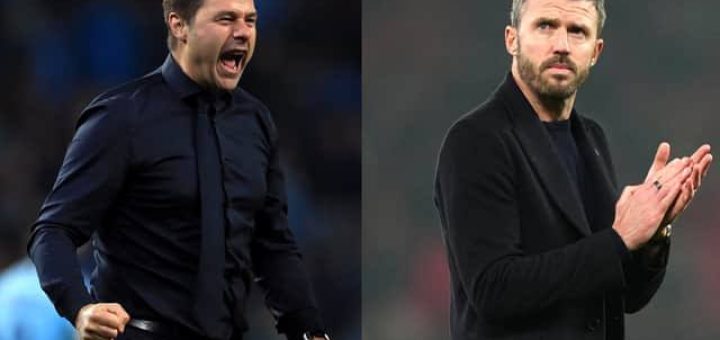
By Frank Ofili
There is something fundamentally wrong with Manchester United, and I am beginning to suspect that the problem at Old Trafford is not necessarily the men wearing the red shirts, nor even the men occupying the technical area. The problem may well lie with the men sitting in the boardroom, making decisions about the club’s future.
Consider the irony of what has just happened.
On Wednesday, 11 November 2026, Michael Carrick reported to Carrington and took his players through their training session. Apparently, he was unaware that the club’s leadership had already decided his fate and was making arrangements to bring in another manager. By Thursday, 12 November, Carrick was out of the job, with Mauricio Pochettino reportedly lined up as his replacement.
Think about that for a moment. A man who had signed a two-year contract less than six months earlier, who had been entrusted with the responsibility of rebuilding the team and who had guided the club to Champions League qualification, was apparently allowed to continue performing his managerial duties while the people who employed him were negotiating the arrival of his successor.
What manner of leadership is that?
This reminds me of the rather embarrassing episode involving the Nigeria Football Federation (NFF) under Amaju Pinnick and the then Super Eagles coach, Stephen Keshi, during the 2013 Africa Cup of Nations.
While Keshi was leading his players into battle on the pitch, the Pinnick-led NFF leadership was reportedly busy discussing with a foreign manager about taking over his job. In other words, the coach was prosecuting a tournament for his country while his employers were already shopping for his replacement.
There was, however, a significant difference between the Keshi episode and the Carrick situation. Keshi was winning his matches, even if the team’s performances were not always convincing. He would eventually go on to win the AFCON trophy for Nigeria. Carrick, on the other hand, had managed just one victory in his opening ten Premier League matches this season. His dismissal, therefore, has a much stronger footballing justification than Keshi’s would have had at the time.
But the underlying question remains the same: what does this say about the quality of leadership and the respect an organisation owes to the people entrusted with its responsibilities?
I am not suggesting that a football club must seek its manager’s permission before terminating his appointment. Far from it. Football management is a results-driven business, and no manager enjoys an entitlement to remain in a job indefinitely. But there is a difference between making a difficult decision and handling that decision in a manner that raises serious questions about the leadership culture of the organisation.
And this is where Manchester United’s troubles become particularly interesting.
Let us not forget what Carrick achieved last season. When he took over in January, he inherited a club whose season was threatening to become another embarrassing chapter in its post-Ferguson history. He steadied the ship, restored some competitive spirit and, against the prevailing gloom, guided United to third place in the Premier League and qualification for the UEFA Champions League.
That was no mean achievement. Indeed, it was sufficiently impressive for the club to hand him a permanent appointment and a two-year contract.
Unfortunately, football has a way of humbling even the most promising beginnings. The new season has been disastrous. United have managed just one victory in their opening ten Premier League matches and have found themselves in the relegation zone. That is unacceptable by any standard, particularly for a club of Manchester United’s history, financial muscle and global standing.
So, yes, Carrick’s dismissal can be defended on footballing grounds. But the circumstances surrounding his departure raise a different question: what exactly is the long-term football philosophy at Old Trafford?
Since Sir Jim Ratcliffe and his INEOS group arrived at Manchester United as minority owners, with responsibility for football operations, the club has continued to struggle for a coherent identity. There has been an extraordinary procession of managerial appointments, sackings, restructuring exercises and changes in football administration. Yet the promised transformation remains elusive.
There is a difference between making a difficult decision and handling that decision in a manner that raises serious questions about the leadership culture of the organisation
Ratcliffe is an accomplished businessman. There is no disputing that. But running a successful industrial empire and running a successful football club are not necessarily the same enterprise. Football is not a chemical plant where one can simply change a component, adjust the production process and expect the desired output. It is an ecosystem of people, personalities, institutional culture, sporting philosophy, recruitment, coaching and relationships.
And therein lies the challenge.
Through INEOS, Ratcliffe also has interests in OGC Nice in France and FC Lausanne-Sport in Switzerland. Neither club has become a European football powerhouse under his ownership. Nice has, admittedly, recorded respectable league finishes and secured European qualification, while Lausanne has returned to the Swiss top flight and regained European exposure. But these are hardly the sort of achievements that establish a record of exceptional football leadership.
The question, therefore, is not whether Ratcliffe has the financial capacity to invest in football. It is whether he possesses the football administration instincts, patience and strategic vision required to build a consistently successful football institution.
At Manchester United, the evidence so far is hardly reassuring.
One begins to wonder whether the club has mistaken corporate restructuring for football reconstruction. You can reorganise departments, appoint new executives, hire consultants, change the manager and redesign the organisational chart. But if the underlying football philosophy is defective, all you are doing is rearranging the furniture in a house whose foundation is cracking.
And now comes Mauricio Pochettino.
I have my reservations, although I would not dismiss him as a serious managerial candidate. He is an accomplished coach with a respectable record, particularly in England. His greatest managerial achievement, in my assessment, remains his work at Tottenham Hotspur.
When Pochettino arrived at Spurs in 2014, he inherited a club that was ambitious but had not established itself among the genuine heavyweights of English and European football. He set about building a competitive side, developing young players and creating a recognisable football identity.
The results were impressive.
He took Tottenham to third place in the 2015/16 Premier League season and then to second place in 2016/17, accumulating 86 points. That was Tottenham’s highest Premier League points tally at the time. He also secured four consecutive top-four finishes and, most memorably, led the club to its first-ever UEFA Champions League final in 2019.
Tottenham eventually lost that final to Liverpool, but reaching it was itself a remarkable achievement. What made the accomplishment particularly impressive was that Pochettino built a formidable team without the financial resources enjoyed by some of Europe’s wealthiest clubs.
He helped develop players such as Harry Kane and Dele Alli into major football talents, while constructing a team capable of competing with the established giants of English football.
That, to me, was managerial craftsmanship.
At Paris Saint-Germain, Pochettino also won silverware. His honours included the 2020 Trophée des Champions, the 2020/21 Coupe de France and the 2021/22 Ligue 1 title. Those are respectable achievements, but there is a distinction between winning trophies with a club that already possesses enormous financial resources and transforming a club into a serious contender against the odds.
PSG had the resources, the star players and the institutional expectation to dominate French football. Pochettino’s Tottenham achievement required a different kind of managerial ingenuity.
He has since managed Chelsea and taken charge of the United States national team. His experience is therefore not in question. But whether he is the right man to restore Manchester United is another matter entirely.
Manchester United is not simply another managerial appointment. It is a club burdened by history, expectation, commercial pressure and a fan base that has watched its once-formidable institution drift from one crisis to another.
A football manager can be responsible for a team’s poor results. He can get his tactics wrong, make questionable substitutions, mismanage players and lose the dressing room. But when one manager after another arrives, encounters similar institutional difficulties and eventually departs, it is only reasonable to ask whether the problem lies somewhere beyond the technical area
Pochettino may bring tactical ideas, discipline, intensity and a philosophy of developing players. But will he be given the institutional stability required to implement them? Will the club’s hierarchy allow him to build, or will he become another occupant of the Old Trafford managerial revolving door?
That is the question I would like Sir Jim Ratcliffe and his fellow decision-makers to answer.
Because, frankly, Manchester United cannot continue to sack managers as though the managers are the only defective components in the organisation.
David Moyes came and went. Louis van Gaal came and went. José Mourinho came and went. Ole Gunnar Solskjær came and went. Erik ten Hag came and went. Rúben Amorim came and went. And now Michael Carrick has joined the list.
At what point does the club begin to interrogate the quality of its own leadership?
A football manager can be responsible for a team’s poor results. He can get his tactics wrong, make questionable substitutions, mismanage players and lose the dressing room. But when one manager after another arrives, encounters similar institutional difficulties and eventually departs, it is only reasonable to ask whether the problem lies somewhere beyond the technical area.
There is an old saying that when a man repeatedly changes his barber but continues to have the same bad haircut, perhaps the problem is not the barber.
Manchester United appears to be changing barbers with remarkable frequency.
And unless the people running the club understand that the crisis is fundamentally about more than who occupies the manager’s office, they may soon discover that Mauricio Pochettino is not the miracle worker they are hoping for.
Manchester United does not merely need another manager. It needs leadership that knows what it wants to build, understands how to build it and has the patience and competence to see the project through.
Until then, Old Trafford may continue to be a graveyard of managerial ambitions.
And that would be a sad fate for a club that once taught the rest of the football world what greatness looked like.