Shut Up Okpebholo! Fuel is Not Prosperity
141 views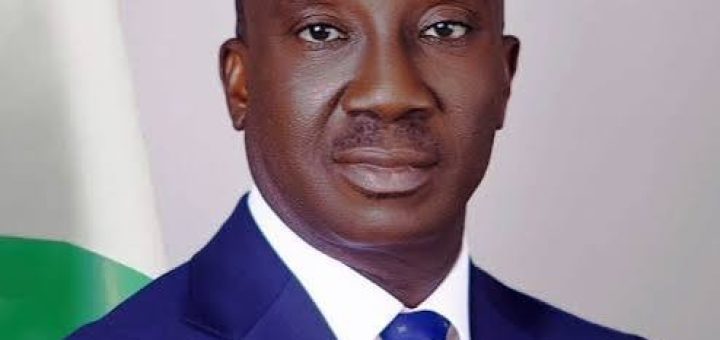
By Frank Ofili
A country is not prosperous because its petrol is cheaper than another country’s petrol. Its people are prosperous when their incomes, purchasing power, public services, institutions and quality of life enable them to live with dignity.
I think I have earned the right and authority to tell Edo State Governor, Monday Okpebholo, to shut up.
First, by African standards of culture and tradition, which place a premium on age, I can tell the Governor to shut up when I believe he has “misyarned.” I am considerably older than he is, and there is, after all, a certain wisdom and experience that comes with age.
Second, by virtue of his office, he is supposed to be my political servant—never mind that in Nigeria we sometimes behave as though the reverse is the case. I therefore reserve the right, as a citizen, to call him to order when he derails.
And the Governor has just derailed, nay, “misyarned”. For the umpteenth time!
There are comparisons that illuminate. There are also comparisons that merely confuse.
Governor Monday Okpebholo’s recent comparison of the price of petrol in Nigeria with the price in Britain belongs firmly in the second category.
The Governor said that while Nigerians complain about the price of petrol, he travelled to London, bought fuel with a friend, converted the price into naira and discovered that it was about ₦3,000 per litre. His conclusion?
“We are doing very well here.”
That is an astonishingly narrow way of measuring the economic condition of a country.
Yes, petrol in Britain may convert to more naira per litre than petrol in Nigeria. That fact, by itself, proves almost nothing about whether Nigerians are economically better off than Britons.
If the Governor wanted to compare Nigeria with Britain, he should have compared incomes with prices, not merely prices with prices.
That is basic economics.
The UK’s National Living Wage for workers aged 21 and above is £12.71 an hour from April 2026.
So the sensible question is not:
“How much is one litre of petrol in Britain after converting it to naira?”
The sensible question is:
“How many minutes of work does a British worker need to buy one litre of petrol, and how many minutes does a Nigerian worker need?”
That is where the comparison begins to acquire meaning.
And fuel affordability is only one part of the story.
Britain and Nigeria are not economies at the same level of income, institutional development, public infrastructure, social protection or public-service provision. They have different tax systems, labour markets, healthcare arrangements, transport systems, utilities, regulatory institutions and social safety nets.
Therefore, extracting one commodity price from one country and placing it beside another country’s price is like comparing the price of a loaf of bread in two houses while ignoring the salaries, house rent, electricity bills, schools, hospitals and bank balances of the people living in those houses.
It is not economic analysis.
It is arithmetic masquerading as economics.
The Governor’s calculation effectively says:
British petrol: about ₦3,000.
Nigerian petrol: less than that.
Therefore, Nigerians are doing very well.
But that logic is defective.
By the same reasoning, if petrol were ₦500 in a country where the average worker earned ₦20,000 a month, while petrol was ₦3,000 in another country where the average worker earned hundreds of thousands of naira equivalent every month, one would conclude that the poorer country was better off.
Obviously, that would be absurd.
The real economic question is purchasing power.
What matters is not simply how much a product costs, but what proportion of a person’s income is required to purchase it.
That is why economists do not ordinarily measure national prosperity by taking the price of one commodity and converting it into another currency.
What did the Governor not compare?
If we are going to compare Nigeria and Britain, then let us compare the things that actually affect people’s lives.
Compare wages.
Compare purchasing power.
Compare inflation.
Compare access to healthcare.
Compare public transportation.
Compare electricity reliability.
Compare water supply.
Compare roads and maintenance.
Compare public education.
Compare social security.
Compare unemployment protection.
Compare pensions.
Compare housing.
Compare taxation and what citizens receive in return.
Compare institutional accountability.
Compare the reliability of public services.
Compare the ease of doing business.
Compare the purchasing power of the ordinary worker.
Then, after all that, compare petrol.
That would be an intellectually meaningful comparison.
But to travel to London, buy petrol, convert the price to naira and announce that Nigerians are “doing very well” is to reduce the economic condition of two vastly different societies to the price displayed on a filling-station sign.
Britain and Nigeria are not economies at the same level of income, institutional development, public infrastructure, social protection or public-service provision.
There is another important point.
The Governor’s calculation treats £1.73 or £1.74 of petrol as though its economic meaning remains unchanged after conversion into naira.
It does not.
Currency conversion tells us the exchange value of the money. It does not tell us the economic burden of the purchase.
A Nigerian earning in naira cannot meaningfully compare his petrol burden with that of a British worker simply by converting the British worker’s expenditure into naira.
The relevant question is: what percentage of income disappears when each person buys fuel?
That is the difference between a price comparison and an affordability comparison.
And affordability is what ordinary people feel.
There is an even bigger issue.
Citizens do not pay governments merely for petrol. They pay taxes and other charges with the expectation of receiving public goods and services. A comparison between countries must therefore consider the relationship between what citizens pay and what citizens receive.
Britain has its own serious economic problems. British households face high housing costs, taxation pressures, energy costs and other cost-of-living difficulties. Nobody should pretend Britain is an economic paradise.
But that does not make the Governor’s comparison valid.
A country can have expensive petrol and still have higher incomes, stronger public institutions and more extensive public services.
Conversely, a country can have cheaper petrol and still have citizens struggling with low incomes, unreliable electricity, inadequate infrastructure, insecurity, expensive transportation and high food costs.
Cheap petrol does not automatically mean prosperity. Nor does expensive petrol automatically mean economic failure.
Perhaps the most troubling aspect of Governor Okpebholo’s statement is not the mathematics of it. Or the attempt to employ a tactic enunciated in Darell Huff’s 1954 classic “How to Lie with Statics”
It is the message.
Millions of Nigerians are struggling with the cost of food, transportation, rent, electricity, education and healthcare. For many families, the removal of fuel subsidy and the resulting increase in transportation costs have had consequences far beyond the price displayed at a filling station.
Against that background, telling Nigerians that they are “doing very well” because petrol happens to be cheaper than in Britain can sound profoundly disconnected from the economic reality they experience every day.
A governor ought to understand that. Leadership is not merely about knowing that £1.74 converts to roughly ₦3,000. Leadership requires understanding what ₦1,000 means to the person who earns ₦70,000 a month.
It requires understanding what rising transport fares mean to the worker who travels two hours each way to work.
It requires understanding what food inflation means to the family with three children.
It requires understanding what the cost of diesel means to the manufacturer.
It requires understanding what electricity costs mean to the small business owner.
It requires understanding what medical bills mean to the pensioner.
That is where economic leadership is tested.
Not at a London petrol station.
The Governor also said of President Tinubu:
“He is an economist.”
Fine.
But economic policy is not validated by the academic or professional description attached to the person implementing it.
The question is what the policies produce.
An economist is expected to understand that economic welfare involves far more than the nominal price of a commodity.
He should understand purchasing power, real income, productivity, inflation, employment, investment, human capital, public finance and living standards.
So should the politicians defending economic policies. Nigeria does not need leaders to tell citizens that things are cheap because somebody somewhere has something more expensive.
Nigeria needs leaders who can explain, honestly and concretely, whether the average Nigerian’s real standard of living is improving.
That is the test.
In fact, Governor Okpebholo should compare Nigeria with Britain.
But let us do it properly.
Don’t compare only petrol.
Compare the worker.
Compare the salary.
Compare the tax burden.
Compare the cost of living.
Compare the quality of public services.
Compare the roads.
Compare the electricity.
Compare healthcare.
Compare education.
Compare public transport.
Compare social protection.
Compare productivity.
Compare institutions.
Compare purchasing power.
And, most importantly, compare the quality of life of the ordinary citizen.
Then we can have an intelligent conversation about which country is “doing very well.”
Until then, converting the price of British petrol into naira and presenting it as evidence of Nigerian prosperity is not a serious economic comparison.
It is simply a calculation. And calculation is not an economic analysis.
A country is not prosperous because its petrol is cheaper than another country’s petrol. Its people are prosperous when their incomes, purchasing power, public services, institutions and quality of life enable them to live with dignity.
That is the comparison Nigeria deserves.