Nigeria Needs a New Diplomatic Language: The Time for Quiet Diplomacy is Over!
47 views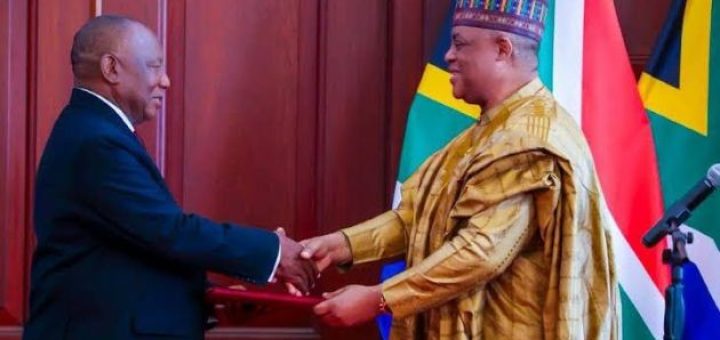
By Frank Ofili
I am not a great fan of Femi Fani-Kayode, Nigeria’s High Commissioner to South Africa. I have never been, and I do not think I ever will be. Indeed, when he was initially nominated as Nigeria’s Ambassador to Germany, I felt it was one inappropriate appointment. Eventually, somehow, his assignment to Germany did not pan out and he was redeployed to South Africa.
However, I must confess that I find his assertive approach to diplomatic relations with South Africa rather interesting. Indeed, I think there is something about his disposition that Nigeria’s foreign policy establishment could learn from.
I think many Nigerians will agree that there is something fundamentally wrong with Nigeria’s diplomatic posture towards certain African countries, particularly South Africa. For too long, Nigeria has appeared to favour restraint, accommodation and quiet protest, even in circumstances where the lives, dignity and legitimate interests of its citizens are threatened.
I think it is time to change that.
Nigeria needs a fundamental reorientation of its foreign policy: from sentimental Pan-Africanism to pragmatic Pan-Africanism; from diplomatic accommodation to strategic reciprocity; and from passive continental leadership to assertive protection of national interests.
This is not a call for diplomatic hostility or adventurism. It is an argument for a foreign policy that understands the difference between being diplomatic and being docile, between demonstrating African solidarity and allowing that solidarity to become an excuse for the mistreatment of Nigerian citizens.
While diplomatic engagement remains indispensable, the recurring xenophobic attacks against Nigerians in South Africa raise legitimate questions about the effectiveness of Nigeria’s traditional approach. Has our diplomacy produced sufficient deterrence? Has it secured adequate accountability? And, more importantly, has it sufficiently protected the lives and interests of Nigerians living in that country?
To be fair, Nigeria has not been entirely passive. It has summoned South African diplomatic representatives, demanded investigations into the deaths of Nigerian nationals, engaged the South African government at ministerial level and facilitated the evacuation of Nigerians caught up in waves of anti-foreigner hostility. These are legitimate diplomatic responses. However, the persistence of the problem suggests that more sustained, strategic and assertive engagement is necessary.
I therefore believe Nigeria needs to modify its approach to diplomatic relations, particularly with other African countries. Afrocentric foreign policy and Pan-African solidarity must not become synonyms for diplomatic subservience or docility.
Perhaps it is time to move beyond the familiar culture of diplomatic niceties and embrace a more assertive, unconventional but entirely legitimate approach to international relations.
In this regard, the conduct of Nigeria’s new High Commissioner to South Africa (with concurrent jurisdiction over Lesotho, and Eswatini), Femi Fani-Kayode, offers an interesting departure from the conventional diplomatic mould.
Fani-Kayode is not exactly a conventional diplomat. He is outspoken, combative, intellectually forceful and rarely inclined to suffer what he considers an affront to national dignity in silence. His approach is characterised by direct communication, historical reminders, an unapologetic defence of national interests and a willingness to confront uncomfortable issues publicly.
Diplomacy should not be confused with timidity, and national dignity should not be sacrificed on the altar of diplomatic politeness.
The recent controversy surrounding the omission of his address from the South African Presidency’s livestream of the presentation of credentials ceremony provides an interesting illustration.
On November 13, 2026, Fani-Kayode presented his letters of credence to President Cyril Ramaphosa alongside other newly accredited diplomats. His address was not captured in the initial livestream, which appeared to have experienced an interruption shortly before his turn. Fani-Kayode publicly protested the omission and questioned the treatment of Nigeria’s delegation. The South African Presidency subsequently released the full recording, including his speech.
Whether the omission was deliberate or simply the consequence of a technical disruption is a separate question. What is noteworthy, however, is Fani-Kayode’s unwillingness to allow an incident he considered disrespectful to pass without publicly raising the matter.
One may disagree with his style or question the wisdom of conducting certain diplomatic disagreements in the public domain. But there is something worth considering in his approach: diplomacy should not be confused with timidity, and national dignity should not be sacrificed on the altar of diplomatic politeness.
Indeed, his conduct raises a fundamental question: Must Nigeria always play the role of the bigger brother, even when its citizens are being brutalised, humiliated or killed in another African country?
To appreciate the depth of this contradiction, it is necessary to revisit the historical relationship between Nigeria and South Africa.
Nigeria’s contribution to the liberation of South Africa from apartheid was substantial. Successive Nigerian governments provided political, diplomatic and material support to the anti-apartheid struggle, while Nigerian citizens also made personal sacrifices in solidarity with the oppressed Black majority.
Nigeria supported liberation movements, including the African National Congress, and deployed its diplomatic influence at international forums to campaign against apartheid. Its solidarity was not merely rhetorical. Nigerian workers, students and ordinary citizens made financial contributions to the liberation struggle, even when the country itself faced considerable economic difficulties.
The famous solidarity contributions popularly associated with the Mandela Tax reflected the depth of that commitment. Nigeria was therefore not merely a sympathetic spectator during South Africa’s darkest political years. It was an active participant in the international campaign against apartheid.
It is consequently difficult to reconcile that history of African solidarity with the recurring hostility directed at Nigerians in post-apartheid South Africa.
Of course, Nigeria’s support for the anti-apartheid struggle was not an investment for which it should now demand perpetual gratitude. It was a principled commitment to freedom, human dignity and the liberation of an oppressed African people. But neither should that history become a permanent diplomatic liability.
Historical generosity must not translate into perpetual diplomatic indulgence. Nigeria cannot continue to invoke brotherhood and solidarity while its citizens are subjected to xenophobic violence without insisting on tangible accountability.
This brings me to the crux of my argument.
I am not advocating hostility towards South Africa, the severance of diplomatic relations or economic retaliation against innocent South Africans. Neither am I suggesting that Nigeria should abandon the principles of Pan-Africanism.
What I advocate is a more muscular and interest-driven Pan-Africanism, one that recognises that friendship must be reciprocal and that solidarity without mutual respect is little more than sentimentalism.
Nigeria should begin to deploy every legitimate diplomatic instrument available to it.
First, it should maintain a firm and consistent policy of summoning South African diplomatic representatives whenever serious incidents involving Nigerians occur. Such engagements should go beyond ceremonial expressions of displeasure. They should communicate specific demands, establish clear expectations and produce measurable outcomes.
Second, Nigeria must insist on transparent investigations into attacks, killings and other serious violations involving its citizens. Where evidence establishes criminal responsibility, perpetrators must be prosecuted. Where appropriate, victims and their families should receive compensation in accordance with the law.
Diplomatic protests that produce neither accountability nor meaningful corrective action risk becoming predictable rituals.
Third, the Nigerian diplomatic mission in South Africa should strengthen its consular monitoring mechanisms and establish reliable channels through which Nigerians can report threats, harassment, violence and discrimination. Periodic public reports on the welfare and treatment of Nigerian nationals would also help ensure that these matters do not disappear from public attention once the immediate outrage subsides.
Fourth, Nigeria should be prepared to employ reciprocal diplomatic measures where circumstances justify them. This does not mean targeting innocent South African nationals or businesses. Rather, it means making it clear that diplomatic privileges, bilateral cooperation and the benefits of friendly relations must be accompanied by mutual respect and responsibility.
Beyond South Africa, Nigeria must also reconsider its diplomatic relationships with other African countries. Our continental leadership must be founded on mutual respect, strategic interests and reciprocal obligations, not merely on the sentimental assumption that Nigeria must always accommodate everybody because of its population, economic potential or historical contributions to African liberation.
It is time to move beyond the familiar culture of diplomatic niceties and embrace a more assertive, unconventional but entirely legitimate approach to international relations
Nigeria must understand that being a leading African nation comes with responsibilities. But leadership also comes with an obligation to protect one’s citizens and defend legitimate national interests. Leadership is not demonstrated by how much humiliation a country can endure in the name of continental solidarity.
There is nothing undiplomatic about firmness. There is nothing uncivilised about demanding accountability. And there is certainly nothing un-African about insisting that Nigerians deserve the same dignity and protection that other African nationals expect for themselves.
The essence of diplomacy is not to avoid disagreements at all costs. It is to advance national interests while managing disagreements intelligently. Sometimes that requires quiet persuasion, discreet negotiations and diplomatic restraint. At other times, it requires an unmistakable public declaration of displeasure and the willingness to follow words with legitimate diplomatic action.
Perhaps Fani-Kayode’s most significant contribution to Nigeria’s diplomacy in South Africa will not necessarily be the particular words he uses or the controversies he generates, both of which, I suspect, Aso Rock does not mind (after all, everyone knew his aggressive nature before his appointment). It may well be the larger question his approach has brought to the fore: Why should Nigeria continue to practise a diplomatic philosophy that places greater emphasis on preserving appearances than on securing tangible protection for its citizens?
Of course, assertiveness must not degenerate into diplomatic recklessness. A High Commissioner is not a political campaigner, and diplomacy is not a street altercation. Every word and action must ultimately serve Nigeria’s strategic interests. There must be a distinction between standing up for national dignity and allowing personal temperament to dictate diplomatic conduct. But neither should professionalism become an excuse for passivity.
Nigeria needs a new diplomatic language: one that combines tact with firmness, dialogue with deterrence, and African solidarity with an uncompromising defence of national interests.
We must learn to be a good neighbour without becoming a willing victim of our neighbours’ excesses. We must learn that Pan-Africanism is not an obligation to tolerate injustice, nor is African brotherhood a licence for the mistreatment of Nigerians.
Friendship is reciprocal. Respect is mutual. And national dignity is non-negotiable.