Tribute To Chief Patrick Isioma Goodluck Onyeobi – The Man We Called “Three Stars”
128 views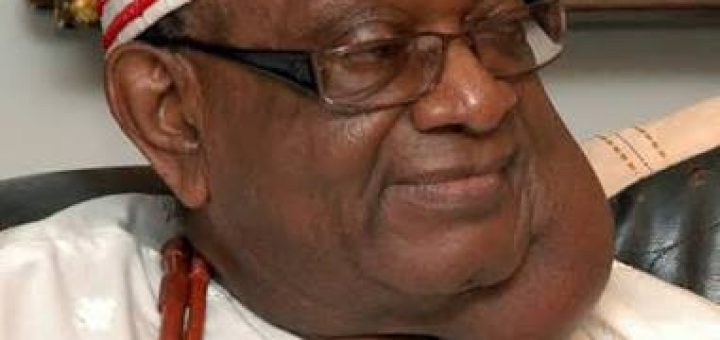
By Frank Ofili
Memory is a strange archivist. It discards entire years without apology and then, with astonishing fidelity, preserves a handshake, a voice, a sentence and an old pen.
More than four decades have passed, but I still remember the man with three dotted patches of grey on his hair.
We called him “Three Stars.”
Never to his face, of course. In the irreverent republic of junior civil servants, senior officers were often awarded unofficial titles without their knowledge or consent. Chief Patrick Isioma Goodluck Onyeobi’s own moniker derived from the three curious islands of grey matter that sat conspicuously on his otherwise dark Afro hair.
Three Stars.
The name stuck.
It was 1983, and I was a young, insignificant typist at the Judicial Service Commission of the old Bendel State. At that age, insignificance has its advantages. Nobody takes much notice of you. You sit quietly at the lower end of the bureaucratic food chain, typing other people’s thoughts and watching important men walk past.
Or so I thought.
My other occupation was reading.
I had discovered James Hadley Chase and, like many young men of my generation, fallen hopelessly under his spell. I devoured his thrillers voraciously. I carried books everywhere. If I was not pounding away at the typewriter, I was likely buried in a novel, wandering through Chase’s dark universe of dangerous women, desperate men and crimes that invariably went wrong.
I did not know that the Permanent Secretary had noticed.
Nigeria itself was in a season of political excitement and gathering uncertainty. The general election had just returned President Shehu Shagari for a second term. In Bendel State, Samuel Ogbemudia – military governor of the defunct Midwest State (1967 – 1975) had just returned to Government House, Benin City, as civilian governor, having defeated Prof Ambrose Alli in the 1983 governorship election.
The politicians were celebrating.
The soldiers, as we would soon discover, were watching.
But that is another story.
Our own little world was located in the left downstairs wing of the State High Court building on Sapele Road, Benin City.
Ah, Sapele Road!
The Judicial Service Commission of 1982 and 1983 remains etched in my memory as one of the loveliest places I ever worked. Perhaps youth has a way of putting soft light around old memories. Perhaps the passing years edit out the quarrels and preserve only the laughter.
Whatever the reason, I remember those days with extraordinary fondness.
We were about 35 employees.
There was the granddaddy-like Mr D.A.E. Omodon, PEO Administration. Robert Percy Idemudia was there. So were S. Odio Omokwo, Pius Offor and S.O. Ighodalo.
There were Paul Imadojemu, Chinwe Osadebay, Iria Izevbikai, Sunday Oriekhi, Lawrence Ikhazobor, Gloria Obi, Peter Imoisili, Monday Omogor and Rosemary Igbinoba.
Names from another time.
Some may have passed on. Others may now be grandfathers and grandmothers; their hair surrendered completely to the tyranny of grey. But in the private cinema of my mind, they remain forever young, walking the corridors of that High Court building on Sapele Road.
There was work.
There was laughter.
There was camaraderie.
And there was discipline.
The High Court itself had its constellation of judicial giants: Chief Judge A.N. Ekeruche, Justice A.N.E. Gbemudu, Justice Rufus Ogbobine and Justice Mrs Alele, among others.
To a young typist, judges were almost mythical beings. Their robes, their measured speech, their solemn movement through the corridors – all carried an aura of distant authority.
But the man who fascinated us most was our soft-spoken Permanent Secretary.
Chief P.I.G. Onyeobi.
Three Stars.
He was not a noisy man. Some people confuse leadership with decibels. They believe authority must announce itself with a raised voice, a clenched fist and a permanently furrowed forehead.
Chief Onyeobi belonged to an older school.
He spoke softly.
But you listened.
Under him, the Judicial Service Commission acquired a reputation for strong ethics and administrative discipline. He did not need to prowl the corridors looking for offenders. The standards were known. The boundaries were clear.
And somehow, we worked.
Then came November 1983.
One day, Chief Onyeobi summoned us to a meeting.
He was leaving.
He had been transferred to the State Civil Service Commission and elevated to the position of Head of Service of Bendel State.
For him, it was a deserved elevation.
For us, it felt like an eviction from a familiar comfort.
We organised a quiet send-off. Or was it a send-forth? I cannot remember when Nigerians abandoned one expression for the other. In 1983, such linguistic controversies were still waiting patiently in the future.
At the ceremony, Chief Onyeobi decided to shake hands with every member of staff.
One by one.
Senior officers.
Junior officers.
Men.
Women.
And then he came to me.
I was the youngest employee in the Commission.
He took my hand and looked at me.
“My son,” he said, “I notice you always carry a book.”
For a moment, I was startled.
The Permanent Secretary noticed me?
The Head of the Commission had noticed the young typist who sat somewhere down the bureaucratic ladder?
He continued:
“The only advice I have for you is to keep it up. Jisike. Don’t relent.”
Then he dipped his hand into the inner pocket of his suit.
He brought out a gold pen.
And gave it to me.
I was speechless.
At that age, when a Permanent Secretary handed you a gift, you did not launch into a speech about mentorship and leadership impact.
Those expressions had not yet been manufactured by management consultants.
You simply stood there.
I muttered, “Thank you, sir.”
That was all.
But memory, that stubborn archivist, kept the moment.
I still have the pen.
Age has not been kind to it. The gold has surrendered to rust and brownish discolouration. It is no longer the handsome pen Chief Onyeobi pulled from his suit pocket that day in November 1983.
But I cannot throw it away.
How do you throw away a piece of your own history?
Sometimes I look at that pen and wonder whether Chief Onyeobi ever remembered the incident.
I suspect he did not.
To him, it was probably a small gesture. An older man encouraging a young employee. A pen given away. A few words spoken.
But therein lies one of the great mysteries of human relationships.
The giver often forgets.
The receiver sometimes remembers forever.
Chief Onyeobi could not have known where my fascination with books would lead. He could not have known that the insignificant typist before him would continue reading and, eventually, find his own voice in writing.
He could not have known that more than forty years later, I would sit before another kind of keyboard – not the noisy typewriters of 1983 – and write about him.
Perhaps that is the true measure of influence.
Not the number of people who applaud when you enter a room.
But the number of people who still remember your words after you have left it.
Patrick Isioma Goodluck Onyeobi was born on 7 August 1933 in Asaba, in what is today Delta State. He attended Government School, Asaba, and Government College, Ibadan, before proceeding to University College Ibadan, now the University of Ibadan, where he studied Modern History.
His was a career forged in the finest traditions of the old Nigerian civil service.
He began in the Western Region Civil Service and moved into the Midwestern Region Civil Service following the creation of the Midwest Region. Through competence, discipline and administrative acumen, he rose steadily: Assistant Secretary, Under Secretary, Deputy Permanent Secretary and Permanent Secretary.
Then, in 1983, he became Head of Service of Bendel State.
Our loss at the Judicial Service Commission became the gain of the wider Bendel public service.
History was also moving rapidly.
Barely weeks after his elevation, Nigeria’s Second Republic collapsed. The soldiers returned on December 31, 1983, bringing with them a new vocabulary of military governors, decrees and command structures.
Chief Onyeobi survived the transition from civilian administration to military rule, not through political manoeuvring, but through the currency every serious civil servant understands. Competence.
From 1984 to 1987, he served as Secretary to the Military Government and Head of Service of Bendel State, working with successive administrations during a difficult period in the country’s history.
After his distinguished civil service career, he continued to serve Nigeria in other capacities. He became a Director of the Nigerian National Petroleum Corporation and Chairman of the Nigerian Gas Company Limited. He also held leadership positions in several private-sector organisations.
Yet Chief Onyeobi never became detached from his roots.
In Asaba, he rose to the revered position of Iyase of Asaba, one of the highest traditional offices in the kingdom. He also served as Diokpa of Idumuojei Village, Umuezei Quarters.
He had travelled from the corridors of the Western Region Civil Service to the commanding heights of Bendel State administration, national corporations and traditional leadership.
But permit me to remember him differently.
Let historians document the offices.
Let governments list the appointments.
Let official tributes enumerate the boards on which he served.
My own memory returns stubbornly to Sapele Road.
To the left downstairs wing of the High Court building.
To the clatter of typewriters.
To files moving from table to table.
To Mr Omodon’s granddaddy disposition.
To Idemudia, Omokwo, Offor, Ighodalo and all those wonderful people with whom I shared the innocence of my early working years.
And, inevitably, to the soft-spoken man with three dotted patches of grey on his hair.
Three Stars.
I remember his handshake.
I remember the look on his face.
I remember his words.
“My son, I notice you always carry a book.”
Then the gold pen.
Chief Patrick Isioma Goodluck Onyeobi died in April 2024 at the age of 90.
Edo and Delta mourned a distinguished son of the old Bendel State. Tributes described him as a consummate administrator, a mentor, a philanthropist and a community builder.
All true.
But somewhere among those grand tributes is the story of a young typist.
A boy, really.
An insignificant employee who loved James Hadley Chase and carried books around the office.
The Permanent Secretary noticed him.
He encouraged him.
He gave him a pen.
More than forty years later, the young typist is no longer young.
James Hadley Chase has long since vacated the centre of his reading universe. The old typewriters have disappeared. Bendel State itself has vanished from the map, yielding place to Edo and Delta.
Many of the people who walked those corridors have scattered to the four winds.
And Three Stars is gone.
But the typist is still reading.
He is still writing.
The pen has become rusty and brown with age.
The words remain golden.
“Jisike. Don’t relent.”
I did not, sir.
I did not. I heed your advice, resigned from the organization you headed and furthered my education.
May your soul continue to rest in peace, sir.
Iseee!!!