Strait of Hormuz Blockade: Strategy, Legality, and the Narrow Path to Peace
134 views
By Frank Ofili
The commencement of a U.S.-imposed naval blockade of the Strait of Hormuz marks a defining moment in the evolving conflict with Iran. While the stated objective appears to be to restrict Iran’s oil revenue and force it to negotiate, the broader implications are far more complex, raising critical questions about effectiveness, legality, and global stability.
At its core, the blockade is designed as an economic lever. By disrupting Iran’s oil exports, the United States aims to weaken Tehran financially and compel it to negotiate on terms favourable to Washington.
However, history suggests that such strategies rarely produce decisive outcomes. Iran is not without options. For one thing, Iran could resort to alternative trade mechanisms, including the use of shadow fleets (ship-to-ship transfers, and reflagging)
Iran could sell its oil at discounted rates to willing buyers. This is not to mention the fact that historically, countries like China and India have always engaged with Iranian oil flows even under sanctions regimes. It is doubtful if this blockade can stop them.
The US blockade of the Strait of Hormuz creates a legal paradox
In addition to these strategies, the blockade targets ships entering/exiting Iranian ports, not all traffic in the Strait, thus giving Iran some level of maneuverability.
So, the likely outcome of the blockade? Not a complete shutdown of Iran’s revenue, but a reduction accompanied by adaptation. Economic pain may increase, but so too may political resistance.
But the blockade may result in the formation of a geopolitical fault line (a zone marked by tension between countries, regions, or groups where conflict is likely to erupt and persist). This is a prospect no one is sure the US has factored in.
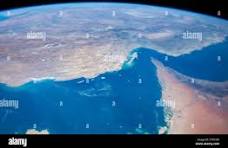
The Strait of Hormuz
The Strait of Hormuz is not merely a regional passage; it is a global energy artery. Major economies such as China and India depend heavily on energy flows from the Gulf, including Iranian crude.
This creates a strategic dilemma:
- Compliance with the blockade risks energy insecurity
- Defiance risks confrontation with the United States
Rather than direct military opposition, what is more likely is a gradual escalation of:
- Diplomatic resistance
- Sanctions evasion
- Strategic realignment
In effect, the blockade risks transforming a bilateral conflict into a broader geopolitical contest.
Even more so, what is the legal basis of the US blockade? This is perhaps the most contentious question.
Under international maritime law, the Strait of Hormuz qualifies as an international water-way where freedom of navigation is protected. Yet, blockades occupy a different legal space, traditionally governed by the laws of armed conflict at sea. Article 38 of the UN Convention on the Law of the Sea (UNCLOS)
Guarantees the right of transit passage through straits used for international navigation. Ships and aircraft of all states have the right to pass continuously and expeditiously. This right cannot be suspended.
Hence, the US blockade creates a legal paradox. In peace time terms, a unilateral blockade appears inconsistent with global navigation rights. In war time terms, it may be arguable, if certain strict conditions are met. Thus, the result is a legal grey area, where interpretation is shaped as much by power as by principle.
The most profound risk may not lie in what the blockade achieves, but in what it triggers.
- Disrupted oil flows could drive up global energy prices
- Economic shockwaves may affect both allies and adversaries
- Iran, under pressure, may escalate rather than concede
In trying to force resolution, the strategy may inadvertently prolong and deepen the conflict.
What, then, is a more viable path forward?
If the objective is sustainable peace rather than tactical advantage, recalibration is necessary.
- Multilateral engagement: Involving key stakeholders, including major energy consumers since a unilateral approach is unlikely to hold.
- Phased de-escalation: Confidence-building measures such as limited sanctions relief in exchange for verifiable commitments
- Security guarantees for navigation: Ensuring the safety of the Strait as a neutral international corridor should be a shared priority.
- Back-channel diplomacy: History shows that even the most entrenched conflicts often find resolution through quiet, sustained dialogue.
The blockade of the Strait of Hormuz is a high-stakes gamble that sits at the intersection of strategy, law, and global economics. While it may exert pressure on Iran, it also risks widening the conflict and destabilizing the very system it seeks to influence. Peace, in this context, will not come from pressure alone. It will require coordination, compromise, and a recognition that in an interconnected world, coercion has limits, but cooperation does not.